November 4, 2026 · 3 min read
Traditional stone or cladding? How the building, the pieces and the cost differ
The difference between traditional built-in stone, where the courses are laid and concrete poured behind them, and cladding with slabs on a finished wall, which pieces each needs, and how much cladding saves, with a worked example from the calculator.
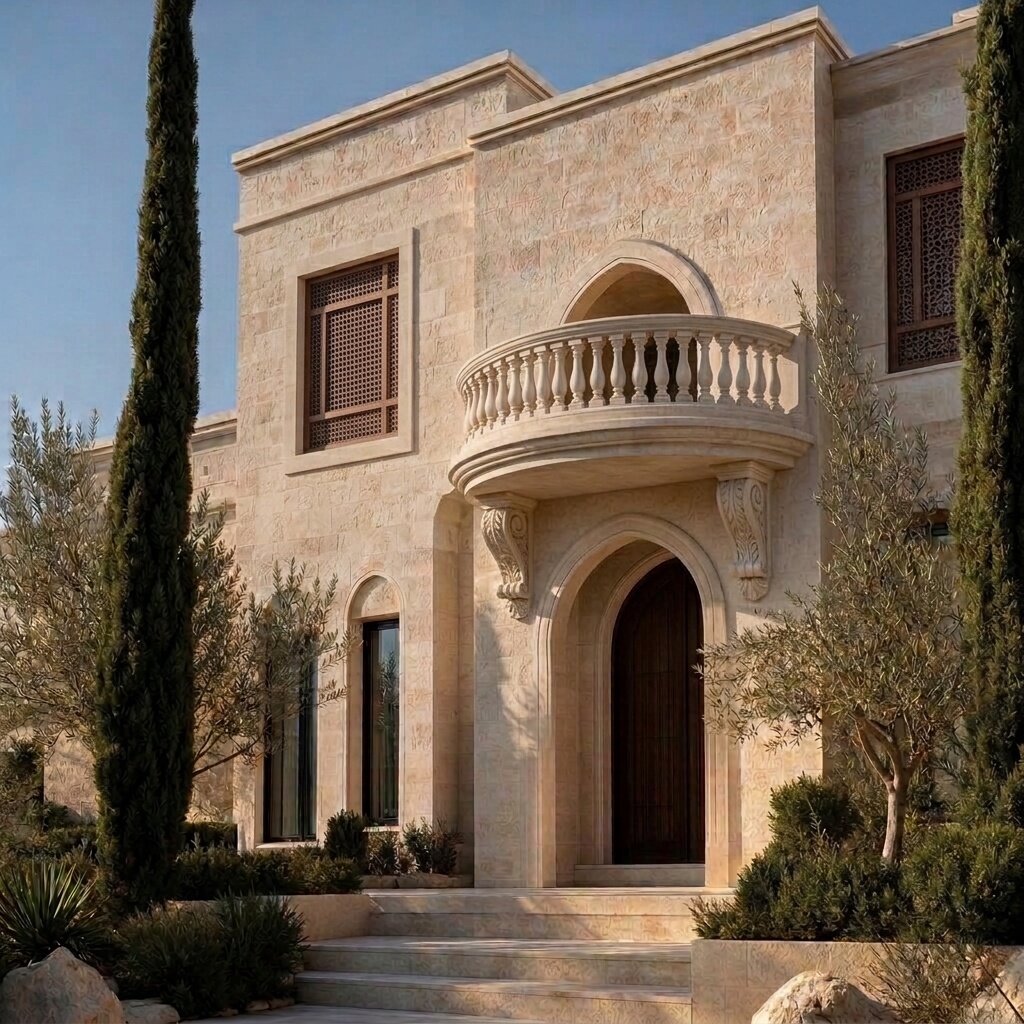
The first question we ask anyone ordering stone for a facade is: traditional or cladding? The answer changes the list of pieces you need, the way the mason works, and about a fifth of the cost. It is also the first thing the quantity and price calculator asks before it counts anything.
Traditional (baladi): the stone is part of the wall
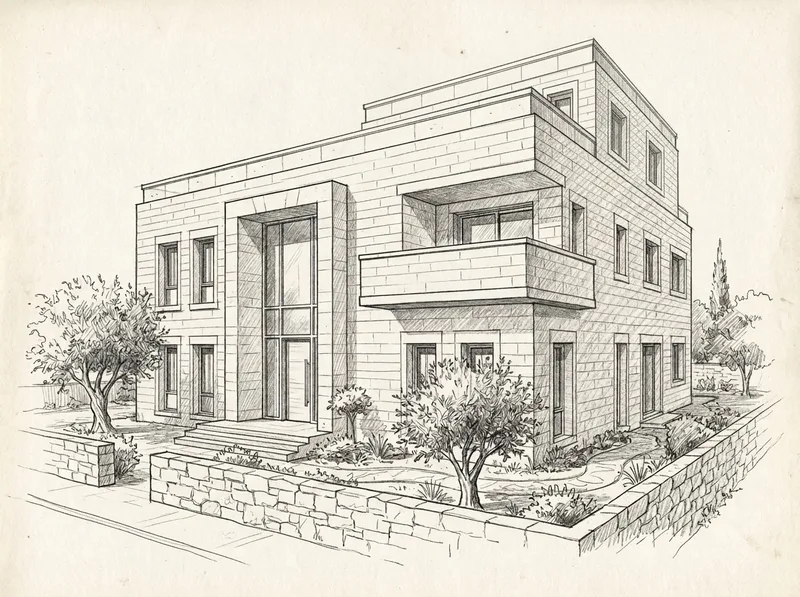
In the traditional Jordanian and Palestinian method the stone goes up first. The mason lays the courses one above the other along the facade, then the reinforcement goes in and concrete is poured behind the stone, so stone and wall become one mass. The stone is not a skin on the wall; it is the wall's outer face and the formwork for the pour.
That is why traditional work needs thick pieces cut for their place, because every corner and every opening has to be closed with a whole stone:
- A quoin at every outside corner, one piece per course up the building.
- Jambs at both sides of every window and door, again one per course.
- A lintel over every window and door, the width of the opening.
- A sill under every window.
- Coping along the roof parapet.
All of these are counted per linear metre on top of the wall stone, and the lintel alone counts as three linear metres for every metre of it, because it is one long whole piece. Traditional stone is always 4 cm thick.
Cladding (talbees): slabs on a finished wall
In cladding the concrete or block wall is built first, complete, and the stone slabs are then fixed onto it with mortar and wire anchors or clips. The slabs meet at the corner with no corner piece and frame the window with no jamb and no lintel, because the wall behind them carries the load. Wall stone only, plus waste.
This is the usual method in the Gulf states, and it is used in Jordan too. It is 4 cm thick here and 3 cm in the Gulf, and the thickness does not change the price per metre, only how much a pallet holds.
The example: a two-storey villa in Amman
We took a family villa of 18 × 14 m on two floors, with twenty-four windows and three doors, in Ma'an stone with the musamsam finish, at 5% waste. These are the calculator's figures today, and they move with prices:
| Traditional | Cladding | |
|---|---|---|
| Wall stone | 1,974 lm | 2,172 lm |
| Quoins | 135 pcs | — |
| Window and door jambs | 309 pcs | — |
| Window and door lintels | 55 lm | — |
| Sills and coping | 51 + 78 lm | — |
| Estimated price | 14,980–23,160 JOD | 11,940–18,460 JOD |
Two things to notice. First, the wall stone is higher for cladding, because the slabs cover the corners and window edges that the pieces used to cover. Second, the total is still about a fifth lower, because the pieces are what cost: lintels at three times, jambs and quoins piece by piece.
Which should you choose?
- Choose traditional if you are building from the foundations and want the strongest and finest facade, with full stone corners and real lintels. This is the Amman house as it has been built for a century.
- Choose cladding if the wall already exists, if you are in the Gulf, or if the budget decides. You get the same stone in the same finish and save about a fifth.
Either way, we deliver the whole quantity from one quarry in one colour before you start. Run your building through the calculator both ways, and send us your drawings for the exact quantity.
Mentioned in this article
#traditional#cladding#baladi#talbees#stone pieces#cost